

On July 7, 2026, I was invited to a meeting with Mr. K. Schipperheijn, Director of Vogelbescherming Nederland (VBN), Ms. S. van der Marel, Chairwoman of the VBN Members' Council, and Ms. M. van Rooij and Ms. W. Wingelaar, members of the VBN Supervisory Board. The reason for this was an “unworkable situation” with a long history.
I have been a member of VBN for over 50 years and a bird veterinarian for over 42 years. As a member of VBN and as a bird veterinarian, I advocate for the interests, rights, welfare, and health of birds. This applies to birds in the wild as well as to birds kept in captivity. As a member of VBN and as a bird veterinarian, I have been raising the alarm for 15 years because, for all those years, VBN has maintained a policy promoting feeding birds in gardens year-round with commercially available seed mixes.
In January 2015, I was invited by VBN to elaborate on my critical questions, and a presentation was given to 8 policy officers. Based on research published in 1986 and 1989 by Dr. Th. Smit, head of the Bird Mortality Working Group, it has been demonstrated that feeding birds year-round is not in the birds' best interest and is even harmful to them. Mortality has been explicitly demonstrated among young birds fed seeds/nuts by their parents.
These adverse consequences of feeding seed mixtures have been known within my field for over 46 years.
Not only because it is a cause of mortality among young birds, but also because commercially available seed mixtures are the cause of structural nutritional deficiencies with adverse health consequences. It has been shown that seed mixtures have an unfavorable effect on the immune system and a detrimental effect on reproduction. Furthermore, the seed mixtures from VBN are not yet organic. This means that, by definition, insecticides and pesticides are being spread and fed to the birds. This is bad for insects and therefore bad for insectivores. It is also bad for egg development, and thus bad for reproduction and the health of the birds. Especially for the young birds.
The alarm has therefore been raised on this point for many years. In 2022, two samples of VBN seed mixtures were sent to an international laboratory.
The analyses revealed that 3 different insecticides were detected:
- Cypermethrin
- Deltamethrin
- Primiphos-methyl.
In addition, Piperonylbutoxide was detected. This product is added as a catalyst to increase the effectiveness of the insecticides.
Neither after the presentation in 2015 nor after demonstrating that VBN promotes and sells seed mixtures containing insecticides, has VBN never sent a response or contacted me.
In 2024, an article appeared in *de Volkskrant* featuring similar analyses conducted by the Pesticides Action Network (PAN), which once again demonstrated that VBN promotes seed mixtures containing insecticides. The conclusions and recommendations from PAN have been completely ignored by VBN. Since my presentation in January 2025, I have asked VBN what scientific substantiation would show that promoting (even non-organic) seed mixtures is in the interest of the birds.
Because I have experienced, as a member of VBN and as a bird veterinarian, that I have not been taken seriously, I have put myself forward as a candidate for the VBN Members' Council in the hope of being taken seriously in that way. Over the past 3 years, I have experienced being treated and addressed as a whistleblower within VBN and within the Members' Council. During the meeting on July 7, 2026, I once again asked the Director of VBN, the Chairwoman of the Members' Council, and the members of the Supervisory Board the question: “What is the scientific basis for VBN’s policy to substantiate that promoting and feeding birds year-round is in the interest of the birds?”
Once again, no answer was given to my question! The conclusion of the Director of VBN, the conclusion of the Chairwoman of the Members' Council, and the conclusion of the members of the Supervisory Board was that I would have to terminate my membership of the Members' Council, by fair means or foul, as a solution to an “unworkable work situation.” The Director of VBN indicated that my functioning as a member of the Members' Council is detrimental to the organization.
The question of whether VBN’s policy is in the interest of the birds is apparently detrimental to the organization.
There are even more topics/questions that mean my input within VBN is not appreciated. Possibly more on that later. My conclusion is that VBN is not only unbelievable but also unreliable. The Members' Council, the Supervisory Board, and the membership are not receiving the information/truth necessary to arrive at sound policy and to be able to justify that policy.
Birds, insects, nature, and biodiversity are the victims of Vogelbescherming Nederland's policy.
Below is a photo taken by me on July 7, 2026, in the VBN shop in Zeist. In addition to non-organic seed mixes, non-organic fat balls are also being offered and sold.
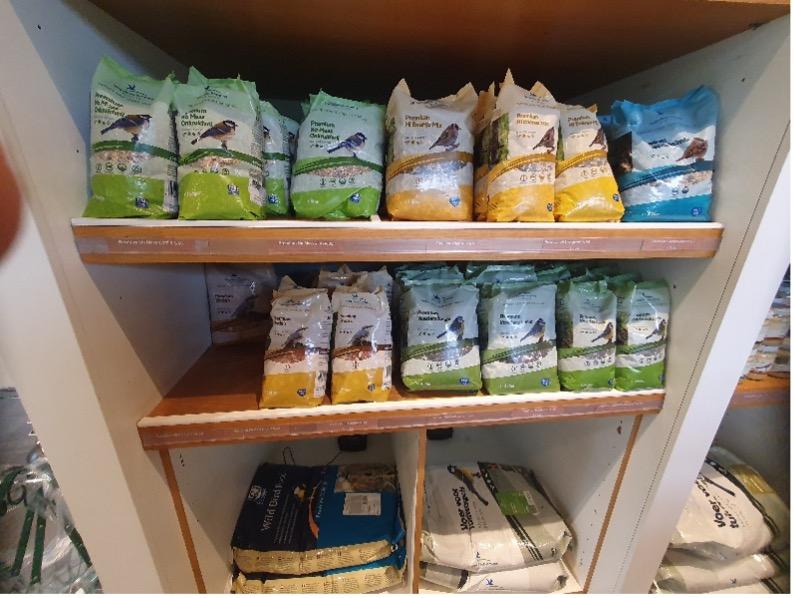
And how contradictory is the policy of Vogelbescherming Nederland? On May 22, 2026, they published the article below:
"Please do not use poison in your garden against snails, ants, or other animals that are causing you a nuisance. There are other solutions that are not harmful to other insects and birds, and that are not unhealthy for you, your family, and your pets.
Tips for a poison-free garden.
It was a wet May: perfect conditions for the army of slugs currently eating the garden bare. Do you ever use slug pellets in such cases? Or ant poison when a black slither marches through your kitchen? Don't do it! The poison is extremely harmful to *all* insects, including bumblebees, bees, and butterflies. The number of insects is already declining so alarmingly fast; let's do everything we can ourselves to help them. The beauty of it: by doing so, we also help robins, wrens, house sparrows, bats, hedgehogs, frogs, and *all* the others." insectivores!
If you help insects, you help insectivores.
Don't worry: the insects actually fare better without poison! Young birds cannot survive without insects. Snails, ants, aphids, and wasps: they are all part of the ecosystem and they all have a role to play. If you feel that they don't always have to fulfill that role in your garden or home, you can prevent potential nuisance with the tips below.
Without poison!
The young birds, in particular, are currently grateful to you, because their diet consists almost exclusively of insects and other small creatures. If you do use pesticides, those chicks have the choice of eating little to nothing, or eating frequently full of toxins..."
VBN is therefore indirectly indicating that young birds do not survive if they are fed seed mixes, and that ultimately the insects suffer the consequences as well.
Seed mixes, especially if they contain insecticides, are harmful to the health of adult birds in the run-up to the breeding season. Promoting and selling non-organic seed mixtures and promoting year-round supplementary feeding with seed mixtures is therefore at odds with what they themselves write in their own article "Tips for a garden without poison".
Conclusion: VBN must follow their own advice better and stop promoting and selling non-organic seed mixtures. They must also stop claiming that year-round feeding with seed mixtures is perfectly possible (even if these seed mixtures are organic).
My functioning as a member of the Members' Council has been made impossible, and following the meeting with Mr. K. Schipperheijn, Ms. S. van der Marel, Ms. M. van Rooij, and Ms. W. Wingelaar on July 7, 2026, I have therefore had to terminate my membership. Unfortunately, I was unable to achieve what I wanted there, but I hope that by telling the story, I can properly inform the reader and convince people that feeding seed mixtures is truly not in the interest of birds in nature.
If everyone stops buying these seed mixtures, then VBN will have no other choice but to stop selling them.
.jpg)