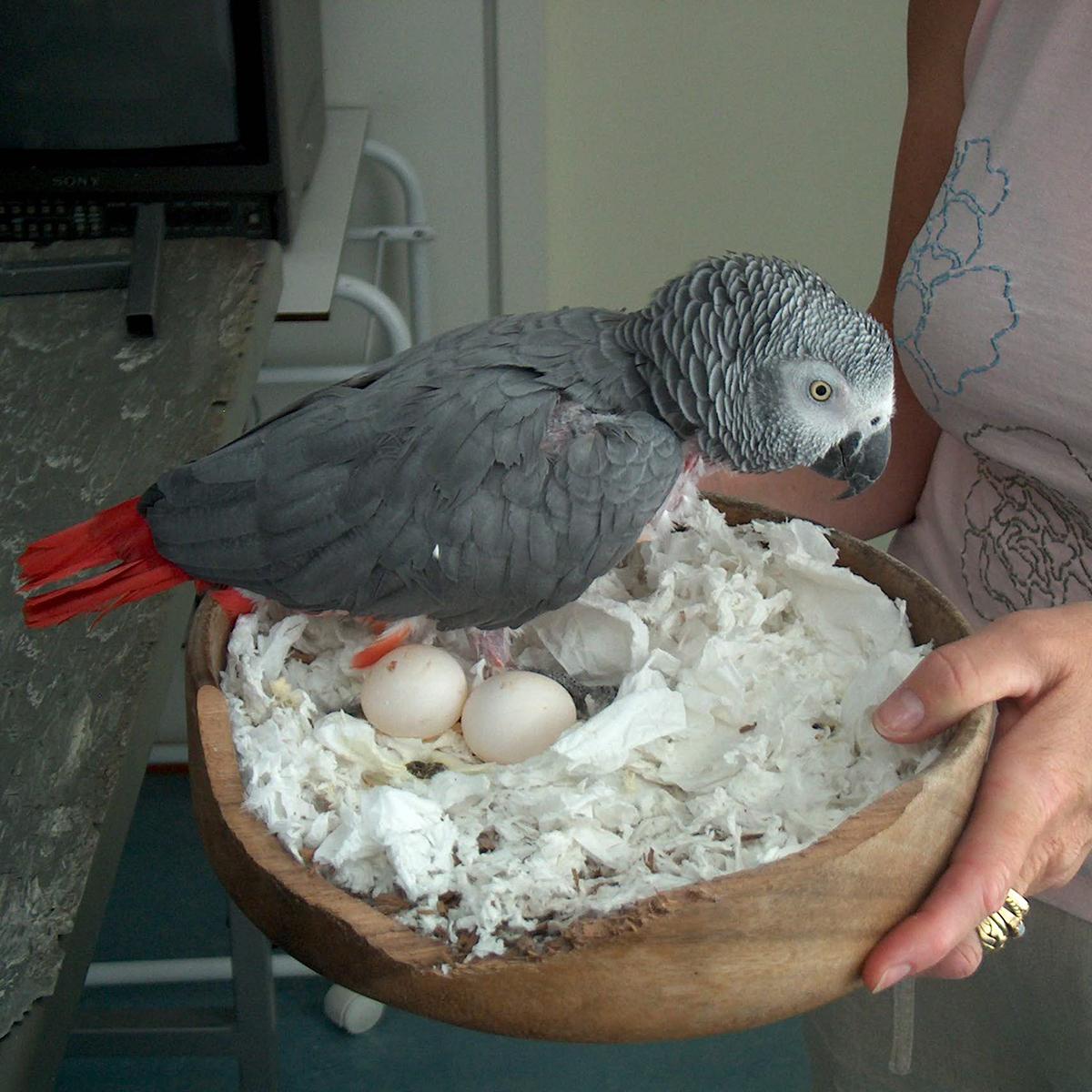
Hormonal behavior (and possibly laying eggs) in a parrot/parakeet as a pet bird. How do we prevent that? It is a complex story.
There are birds (species) that tend to breed all year round. In other birds it may be limited to a limited time/period of the year.
Various factors determine whether birds are/become hormonally active. These factors can vary depending on the species and the individual. Increasing day length is an example of where this is not a factor that will influence hormonal behavior for all species.
In pupae, hormonal behavior can result in egg laying. This is not in the bird's interest.
Factors that can influence hormonal behavior:
- Interaction with a partner in which partner behavior arises due to mistakes in interaction
- Nesting location
- Nesting material
- Climatic conditions, daylight length, rainy season, temperature
- Time of year
- Food supply
For some birds a certain factor plays a greater role than other factors. Responding to the problem is therefore not easy because there is always a combination of factors.
We must assume that it is normal that even individually kept birds can be hormonally active with a certain regularity.
This hormonal activity is extra stimulated if a bird is constantly in a cage, nesting material is available and there is a "partner relationship" with another bird, a mirror, a plastic animal or the owner.
We must realize that the cage is often regarded as a nesting tree/nesting facility.
- During the period when birds in nature are hormonally active and a nesting site has been occupied, the female is often fed by the male. This signal makes it obvious for the female to start laying eggs, with the idea that the male will provide food during this period and during incubation.
- In nature we can see that birds that are hormonally active spend a lot of time in and near the nesting site. This nesting site is defended against other birds that are interested in this place. In nature, birds are always in different locations during the day.
- There are places where food is found and there are places where the birds go to drink. In between, the birds are in locations other than the food or water locations.
- ’At night, birds go to roosts and have an average of 10-12 hours of sleep in total darkness.
- This means that a bird in a cage that spends most of the day there and is fed in that location by its owner will naturally take this situation as a signal of reproduction.
- Feeding a bird in the cage and giving it a piece of apple or a nut means that the parrot will receive a completely wrong signal and will show behavior that in nature is linked to mate behavior and reproduction.
In the Bird Advisory Practice we see that females can lay eggs and that this can involve more and more eggs being laid than in nature because the normal cycle, in which the young grow up and fledge, is not completed.
- Laying eggs takes a lot of extra energy.
- It's normal for females to gain weight in the lead-up to egg laying. Regularly monitoring their weight allows for early detection of changes, allowing early intervention to break the cycle.
- In addition, we see that females can become overweight under the influence of hormones. This also applies to females that don't lay eggs. With persistent obesity, all sorts of complications can be expected.
- Owners are sometimes very surprised that pupae also lay eggs without a male present. The only difference is that without a male the egg will not be fertilized. It's funny that people don't realize that laying hens lay plenty of unfertilized eggs without a rooster being involved.
During periods when the birds are sexually/hormonally active, the birds are extra insecure and territorial. The birds are then extra territorial in and around the cage or with their favorite partner. This partner can be the owner, but also a toy, a ball, etc. Dolls can crawl away in holes, boxes, cupboards or under paper. Lovebirds can make nesting material by making paper strips and inserting twigs between the feathers. Birds can be more one-sided or more cuddly. The birds can give up food to a toy, a mirror, the owner, etc. Mating behavior is also no exception where the birds can show mating behavior on the head or hand of the owner or on the back of a chair, etc. Depending on the species, birds can hang their wings long and make 'luring sounds' such as gray redtails or turn around and lift the tail diagonally to show the cloaca.
Birds that are hormonally active may exhibit picking behavior. Uncertainty plays a role in this. It's also not uncommon to make the nesting area a bit more sparse so that the hen's warmth is more readily available to the eggs. This often involves the thighs and lower abdomen. We also see that there may be some bare spots under the wings.
Especially in dolls, we can see/feel that the laying legs become weaker and wider apart.
Has the bird already laid an egg:
Birds on the traditional seed diet develop severe deficiency symptoms and develop abnormal (wind) eggs, become egg-bound and die at a young age.
It is very important that once the birds have laid eggs, the birds have access to good food. The advice is always to give the birds Harrison's High Potency. Depending on the situation, the quality of the eggs and the general condition of the bird, injections can be given with vitamins/minerals/trace elements.
If the bird lays eggs, it is advisable not to remove the eggs. Removal may encourage the bird to lay more eggs than usual.
- The advice is to let the bird go through the normal breeding cycle.
- After the usual incubation period, the eggs are removed.
- Preventing eggs from being laid:
- To prevent eggs from being laid (again), it is advisable to change the cage, change perches and not provide bedding material.
- It's important to have a good relationship with the bird to prevent it from viewing its owner as a surrogate partner. A "love affair" should be considered undesirable.
- Feeding food or giving something extra out of hand can be regarded as partner behavior in which the male feeds the female during the period when the birds are hormonally active, when the female is breeding or when there are young.
- It is good to realize that birds have no interest in our love but have the right to be treated with respect. We can only show respect on the basis of expertise.
- The most important thing is to break the cycle by doing all kinds of activities with the bird and taking the bird into the kitchen, bathroom, bedroom, etc. In addition, take the bird outdoors as much as possible, on walks and bike rides. In some cases, it can help to break the cycle if the bird is going to stay with them for a while and is away from their familiar surroundings.
- Get out of the cage as much as possible and preferably put the cage away.
Separate sleeping accommodation
The advice is to use a second cage as a sleeping cage. The sleeping cage is in a separate bedroom and the bird goes there in the evening at 8:30 PM to sleep until the next morning.
By offering a place to sleep other than where the bird is during the day, a situation is created that differs from the situation in nature for birds that are sexually active and stay in and near the nest tree as much as possible day and night.
It is important to take the bird outside as often as possible and make it part of family life as much as possible. preferably provide a climbing tree where the cage is placed away as much as possible.
Daylight length
For species that respond to longer days, adjusting the day-night rhythm can be an important tool to limit the number of hours of daylight. Daylight length does not play a role in species that live in their countries of origin around the equator. There, the rainy season and the availability of food are an important stimulus for reproduction. In cockatiels, this daylight length can play a role. It may be useful to offer a short day and a longer night during periods when the birds are sexually active.
Dietary adjustment
It is important to remember that an excess of energy-rich food and a wide variety of extras such as fruit, birds are extra stimulated to lay eggs and also to lay more eggs. If birds start to show hormonal behavior, it is therefore important to ration the food, give a less energy-rich diet and, for example, stop adding additives such as grapes and apple. With a rationed food supply, there is no reason in nature to want to produce eggs because the conditions are unfavorable for the young that are born. The advice is to ration the food in such a way that the birds receive less than normal and in such a way that the bird does not lack anything. Offering feeding blocks and other enrichments is highly recommended.
Very important
Breaking the vicious circle; cycling, walking, staying overnight, etc. and experiencing positive experiences in a different environment. The more the bird experiences without receiving attention, the better.
Other possibilities
It is possible to temporarily stop egg laying through hormonal treatment. This is not recommended within the Bird Advisory Practice. At most in exceptional situations where a female, despite all measures, lays a lot of eggs.
Experience has shown that if the bird stays for a period of time and is admitted, for example, its behavior can change completely in a short time.
In exceptional cases, a hysterectomy can be performed in which the fallopian tube is removed. This is a “major” abdominal operation that we only consider as a last resort if there is no other solution and the health of the birds would otherwise be at risk.
Such birds remain hormonally active but can no longer lay eggs.
In case of "sexual behavior problems", it is recommended to insert a hormone implant, which actually chemically castrates the bird.Hormonal treatments only have a short-term effect and do not prevent problems in the future because it does not solve the cause of the problem. An approach that does not solve the cause, The Advisory Practice for Birds does not consider this to be a serious treatment.
Here too, in such situations a recording in which the bird is in a completely different environment can quickly lead to a desired effect.
Structural behavioral problems due to partner behavior
We must realize that there may be structural behavioral problems that result from the fact that 2 birds, kept as pet birds, start to show partner behavior. The problem is then the result of creating an unnatural situation of which the birds actually suffer. Strict measures may then have to be taken.
In the case of a strong partner bond between the birds, the last resort can be to permanently separate the birds from each other.
A typical example is having a pair of precious parrots as pet birds, where the female is hormonally active, shows strong territorial behavior and the male develops plucking behavior and/or biting behavior. Partner bonding is the main reason for serious behavioral problems and that can sometimes only be solved by separating the couple and providing companionship without the hormonal stimuli. It indicates that purchasing or having a pair of parrots/parakeets does not ultimately have to be in the interests of the birds.
This is why the Advisory Practice for Birds does not advise keeping "a pair" as pet birds. The preference is to have birds of different species act as companions to the other bird. We must realize that several species are known to exhibit mate behavior and that fertilized eggs can even be laid. This is very well known in combinations of the large macaws and amazons.
The advice is always to make an appointment with the Bird Advice Practice so that the overall condition and health of the bird can be assessed and the condition can be improved. A behavioral consultation is very important to break a vicious circle. Many situations are strongly related to the individual circumstances and the “relationship” between the bird and the owner or the relationship of the bird with another bird/'partner'.
Want to know more?
Then book a behavioral consultation
Copyright © Advisory Practice for Birds | drs. Jan Hooimeijer. No part of this publication may be reproduced or copied without written permission from Jan Hooimeijer. Sharing the article in its original form is of course permitted (and even desirable) on the condition that this is always done with clear source information. The article has been compiled with the greatest care. However, the author cannot accept responsibility for any damage of any kind resulting from defects in the content.